| |
|
FAIR Principles |
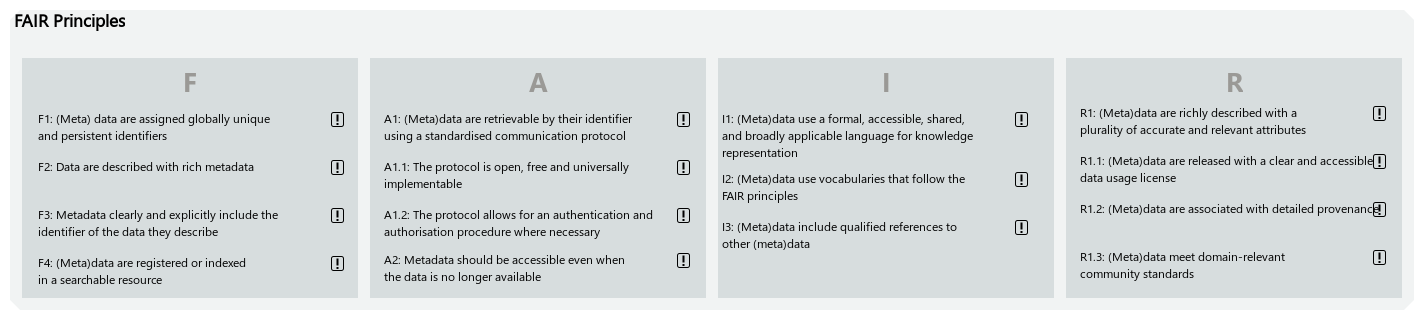
R1: (Meta)data are richly described with a plurality of accurate and relevant attributes |
| |
|
FAIR Principles |
F1: (Meta) data are assigned globally unique and persistent identifiers |
| |
|
FAIR Principles |
A2: Metadata should be accessible even when the data is no longer available |
| |
|
FAIR Principles |
A1: (Meta)data are retrievable by their identifier using a standardised communication protocol |
| |
|
FAIR Principles |
F3: Metadata clearly and explicitly include the identifier of the data they describe |
| |
|
FAIR Principles |
F4: (Meta)data are registered or indexed in a searchable resource |
| |
|
FAIR Principles |
F2: Data are described with rich metadata |
| |
|
FAIR Principles |
I3: (Meta)data include qualified references to other (meta)data |
| |
|
FAIR Principles |
I1: (Meta)data use a formal, accessible, shared, and broadly applicable language for knowledge representation |
| |
|
FAIR Principles |
I2: (Meta)data use vocabularies that follow the FAIR principles |
| |
|
A1: (Meta)data are retrievable by their identifier using a standardised communication protocol |
A1.2: The protocol allows for an authentication and authorisation procedure where necessary |
| |
|
A1: (Meta)data are retrievable by their identifier using a standardised communication protocol |
A1.1: The protocol is open, free and universally implementable |
| |
|
R1: (Meta)data are richly described with a plurality of accurate and relevant attributes |
R1.2: (Meta)data are associated with detailed provenance |
| |
|
R1: (Meta)data are richly described with a plurality of accurate and relevant attributes |
R1.1: (Meta)data are released with a clear and accessible data usage license |
| |
|
R1: (Meta)data are richly described with a plurality of accurate and relevant attributes |
R1.3: (Meta)data meet domain-relevant community standards |